Discovering Dell
I grew up without an abundance of relatives, but the ones I had shaped me completely. Three women, mostly: my grandmother Eve, my great-aunt Ardell (Dell) who married Eve's brother Clair, and my mother, Diane. All of them born and raised in Iowa, me in Illinois, and somehow, by the 1980s, all of us landing together in Northern Arizona.
I loved listening to the old stories, playing with the heirlooms, going through the photographs. That hasn't changed. What's changed is that I'm now old enough to be thinking about the heritage I want to leave behind myself and there are so many questions I wish I could still ask the two women who aren't here to answer them.
Aunt Dell died in May 2014. She was 95, nearly blind, and still somehow the busiest person I knew. This woman with a genuine zest for exploring right up to the end. We'd already lost my Uncle Clair and my grandfather Al by then, but the women held everything together. The following year we lost my grandmother Eve too, the keeper of the stories, the bridge for the whole family, the last elder blood relative who connected all of us cousins to each other. Since she's been gone, the stories have been fading. My mom's cousins are getting older. Some are gone too. It's made me think a lot about the stories we know, the stories we keep, and the stories we simply never got.
What we knew of Aunt Dell's life was curated and you can see the shape of that curation right in her obituary. Born April 13, 1919, on a farm near Zion, Iowa, the only child of Nellie and Eli Gibson. High school in Zion, then business college in Grand Island, Nebraska. Years at Radioplane in Los Angeles, building target drones for the Armed Services. Nebraska, California, New Mexico, Boston, New York — she lived in all of them before, in 1959, marrying my Uncle Clair, a man she'd actually known since she was three years old. She was a member of Lady Elks, Ladies Literary, Women's Club, the Historical Society and the Hospital Auxiliary board. She also was a member of Eastern Star since 1937, the same year, it turns out, that I'm currently transcribing. A seamstress, a jewelry designer, a golfer, a European traveler. Winters in Rio Verde, then a permanent move to Prescott. After Clair died in 1999, she lived out her days at Las Fuentes, losing her eyesight in 2004 without ever losing her spirit.
It's a beautiful life on paper. It also has no children in it, no living relatives by the end, and one line sitting quietly next to all the club memberships "an only child with no relatives that were left" that doesn't quite square with everything else the obituary tells you she built.
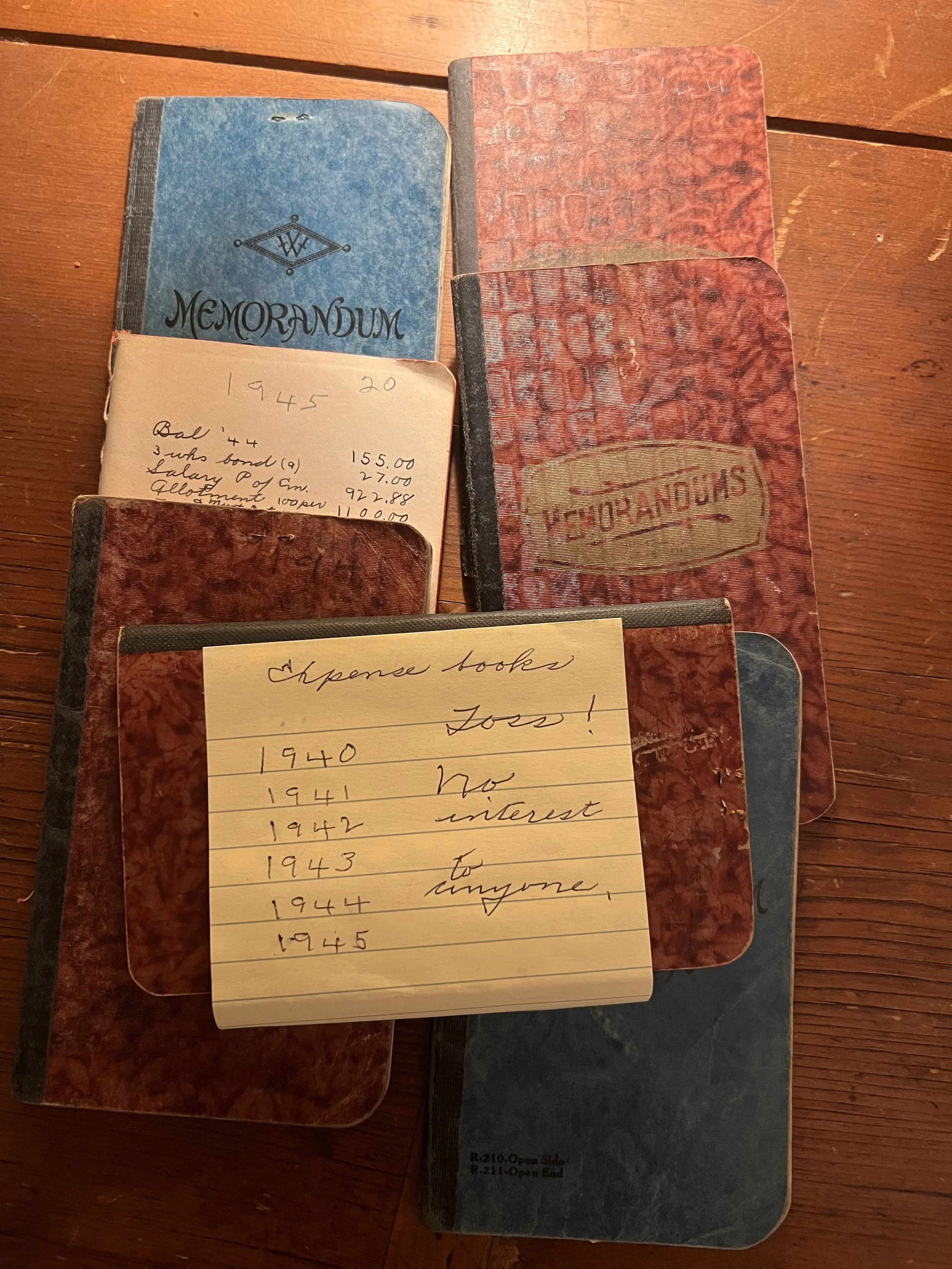
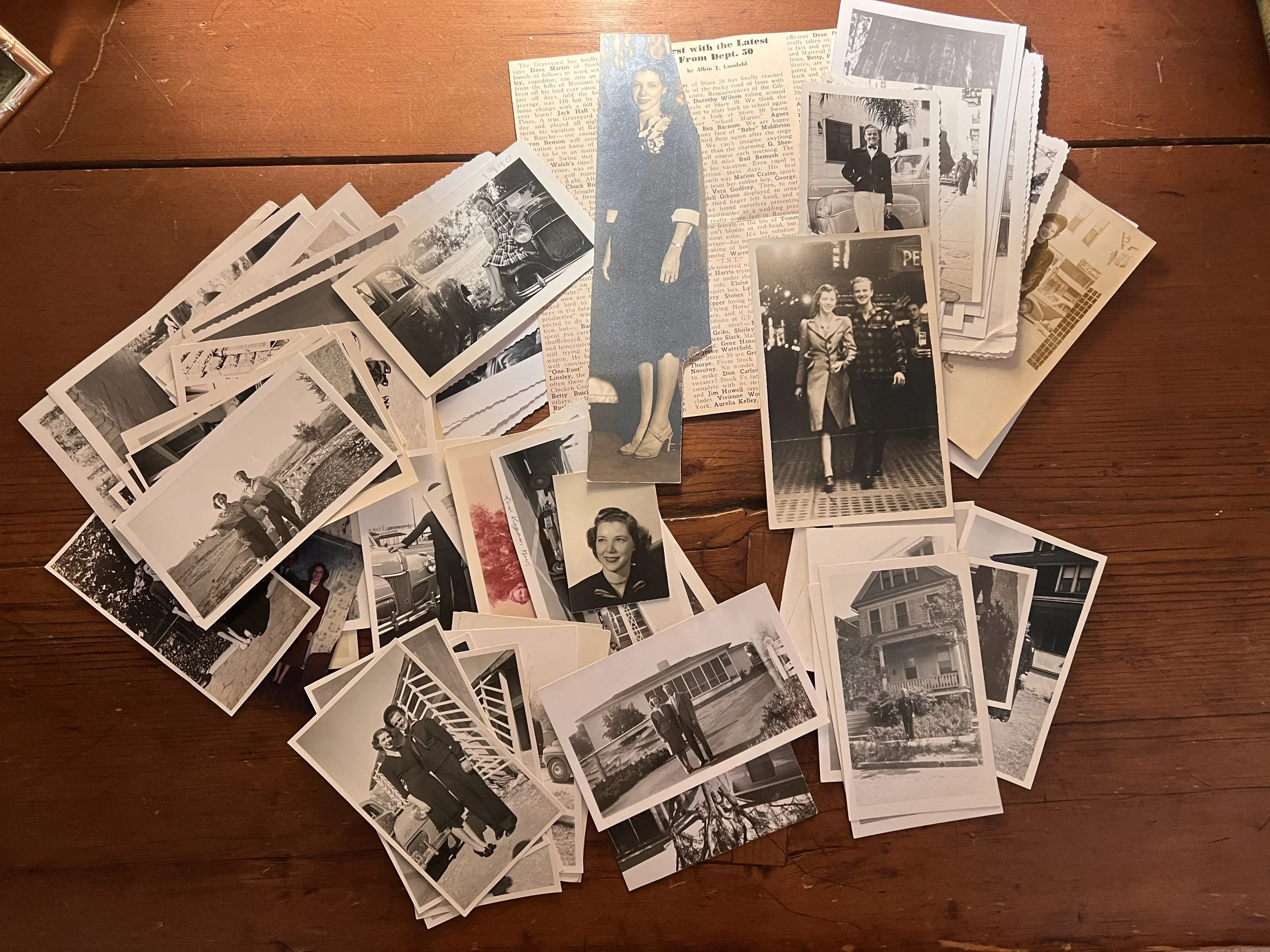
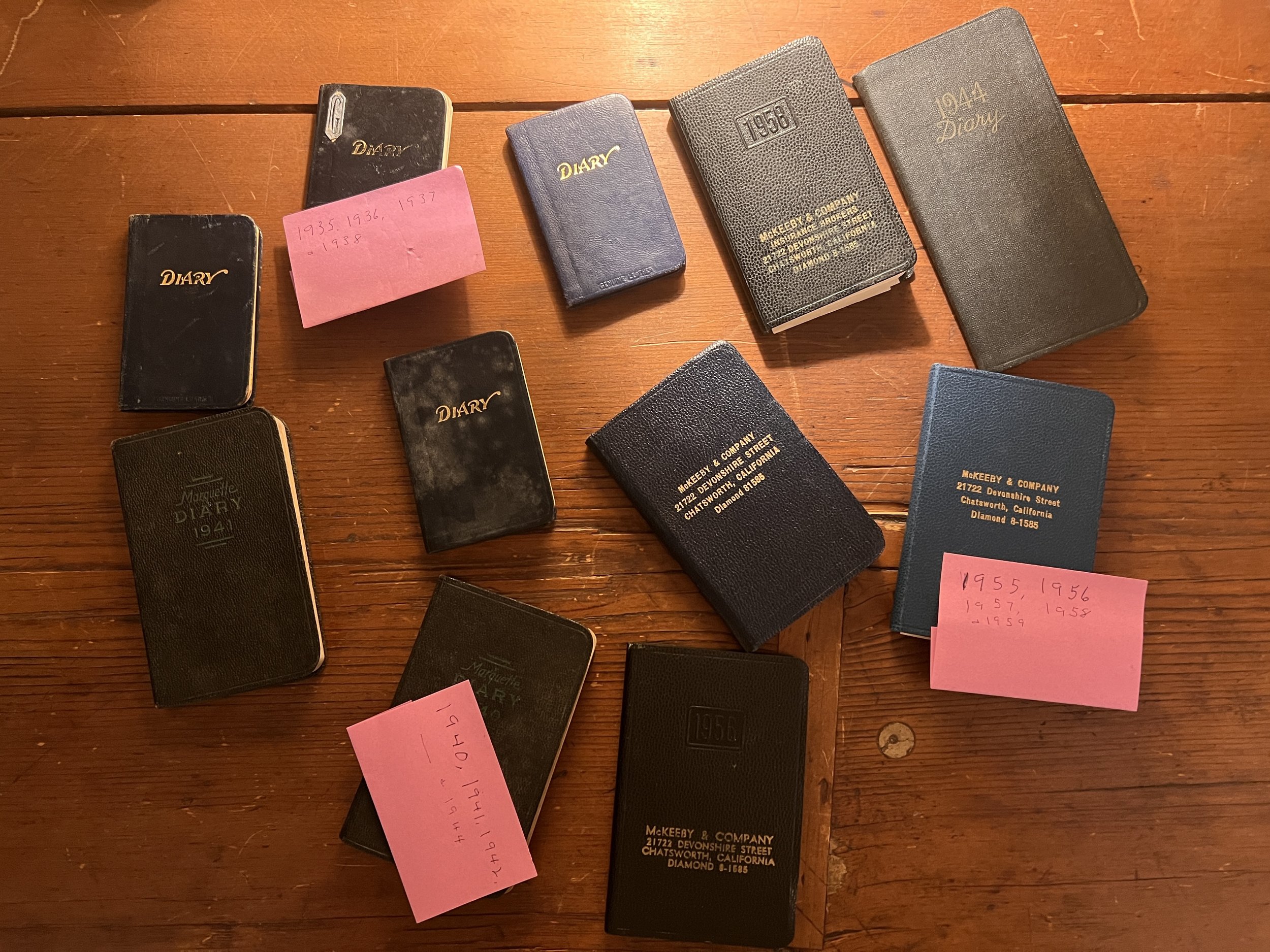
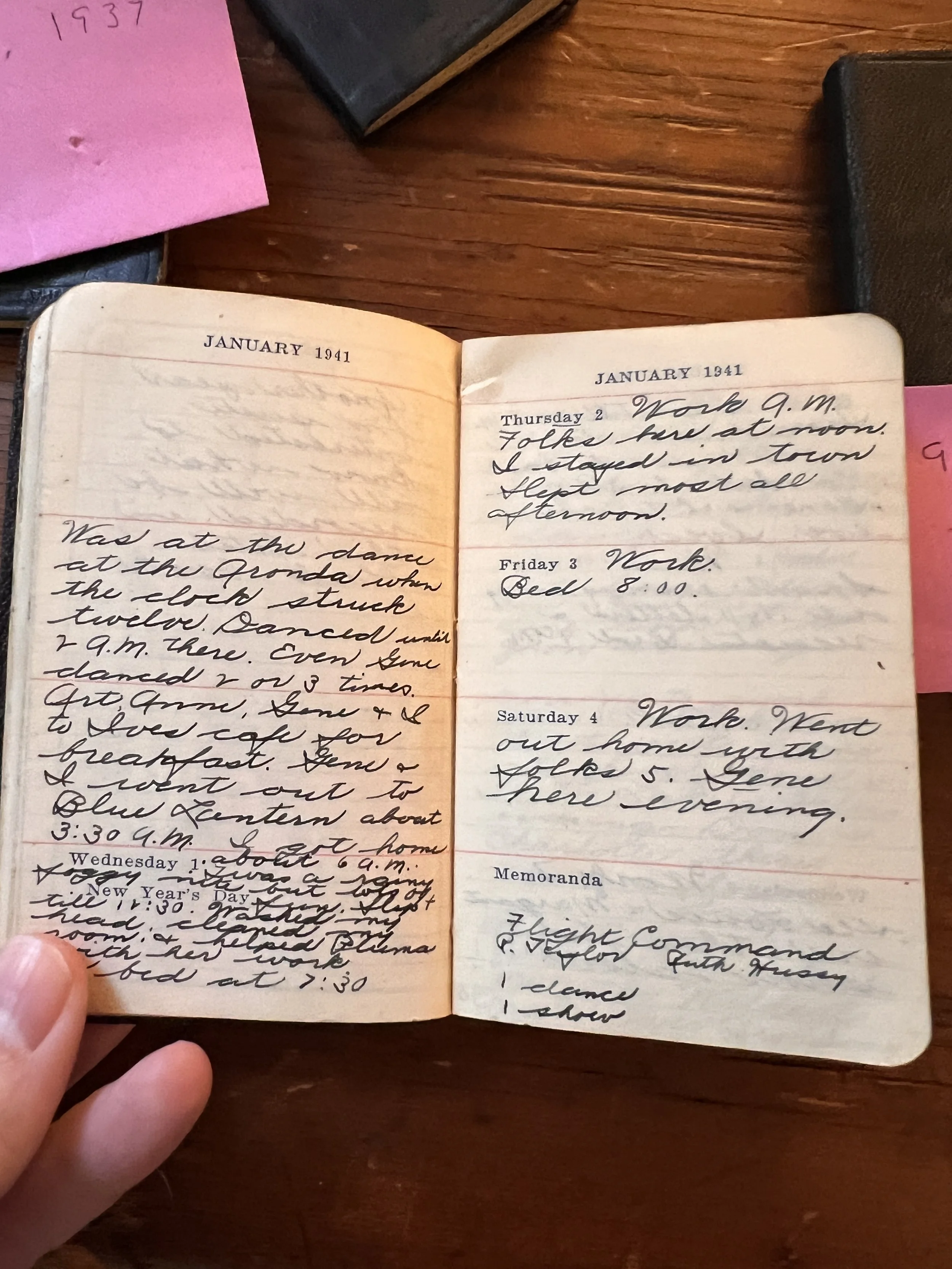
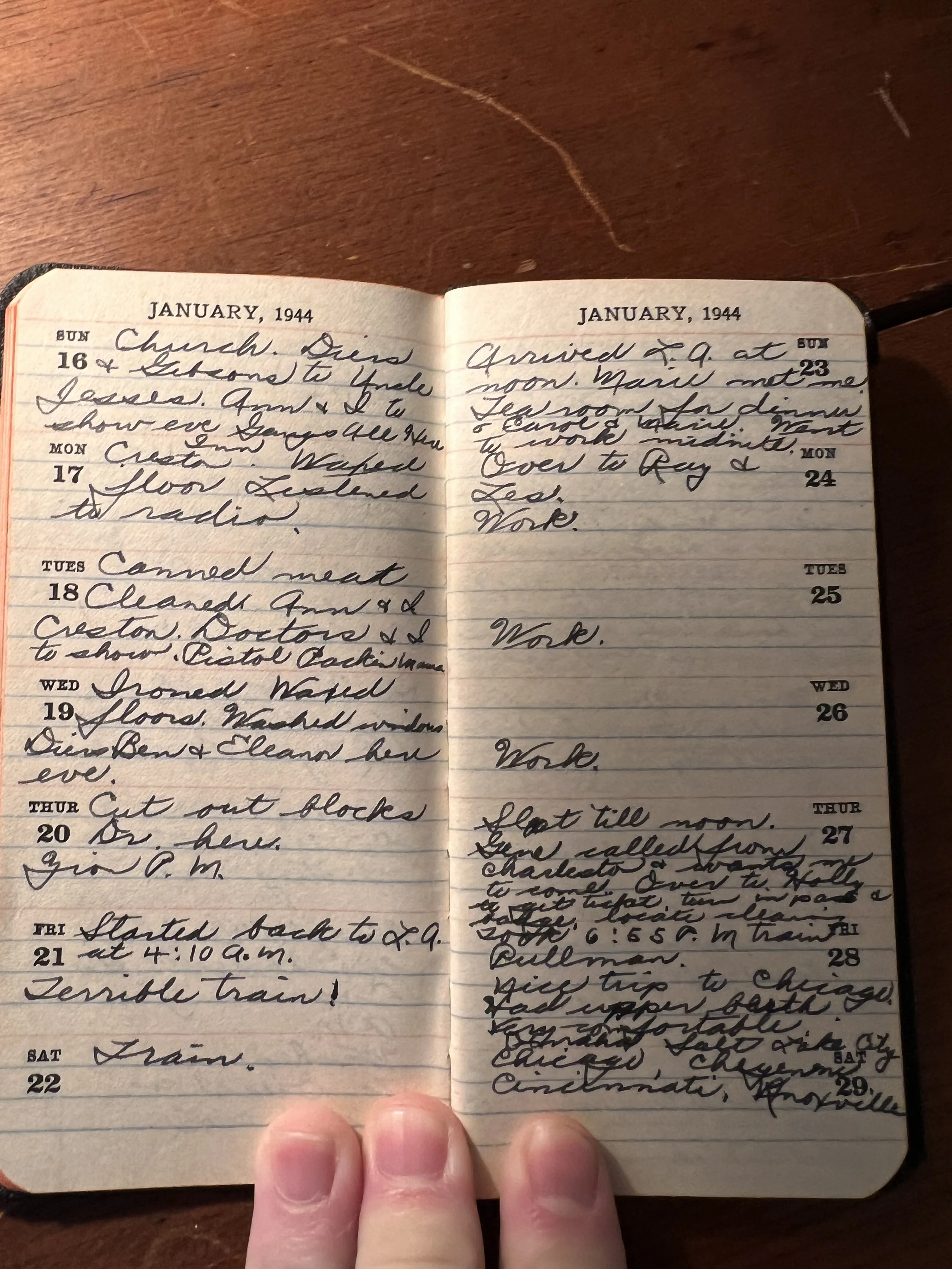
When she died, she left instructions for everything. Dell was a labeler. Hilariously, she saved big empty powder Tide boxes and used them for storage, each one marked clearly, and her will spelled out exactly who should get what, with notes on the history and purpose behind almost every item. One of those Tide boxes wasn’t assigned to anyone, but instead was something that appears she kept only for herself. Inside: a stack of expense books from the 1940s with her own post-it note on top — "expense books. 1940, 1941, 1942, 1943, 1944, 1945. Toss! No interest to anyone." Underneath those, a cluster of tiny Marquette diaries: 1935 through 1938, then 1940, 1941, 1942, and 1944, then 1955 through 1959. That last one currently misplaced, more on that soon. And beneath all of it, a fat envelope of photographs spanning decades, full of a man who was not my uncle.
The story we grew up on was simple and romantic: young, adventurous Dell went out and saw the world, did what she wanted, and eventually came home to fall in love with her childhood sweetheart. By the time I was an adult, I knew there'd been someone before Clair, vaguely. I didn't know how much of her actual life that vague someone touched. That Tide box was the answer to so many things we didn’t know, but also created so many questions that will potentially never be answered.
I always meant to dive into this properly. But life kept doing what life does — deaths, new jobs, falling in and out of love, a pandemic, falling in love again, a wedding, a layoff, moving out of New York — twelve years' worth of you get the idea. Finally building this website gave the project a reason to actually start.
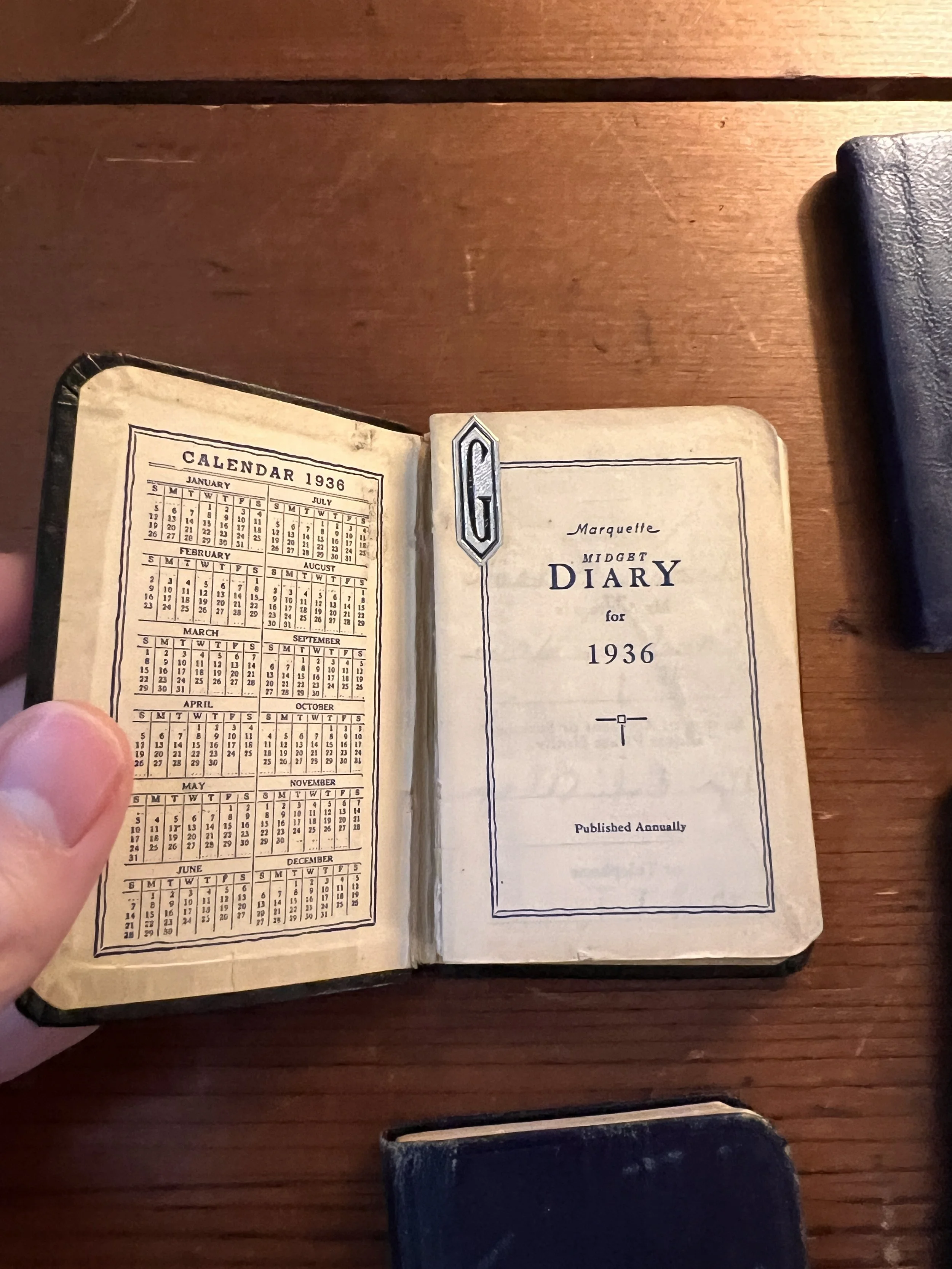
These diaries are brutal to work with. They're tiny, they barely stay open, and Dell's cursive is minuscule. I'm transcribing every one of them in her exact words. Not for an audience, at least not first, but as a record for the family that's left, and for her, because I think she kept them for a reason and they deserve to be read. If you're picturing the confessional, pour-your-heart-out kind of diary, these aren't that. From what I've read about the era, Marquette diaries were a Depression-era habit. Closer to a coping tool than a confession booth, a way of marking that you were still here, still moving, still going somewhere. Dell's are a little more than that, but not by much. And even in a few words a day about places and dances and who drove her home, you can feel exactly who she was: a woman who never once sat still, and never once didn't have somewhere to be or something to wear. That's the Dell I knew, decades later, and it's already unmistakably her at nineteen.
Given how long it would've taken to hand-transcribe every page myself, I leaned on AI to build a first-pass skeleton from photos of the diaries and now my mother and I are reading, verifying, and finishing each one together, page by page, against the originals. This has turned into a gift in two directions at once: a project my mom and I get to do together, and once it's finished, a gift for every cousin and family member still here, a chance to actually hear Dell in her own words instead of the version she gave us starting in the 1960s. Because the more we read, the more it looks like 1959 wasn't just a marriage. It was closer to a reinvention. A woman choosing which parts of her twenties and thirties would survive into the story she told for the next fifty years, and which wouldn't.
My mom was just out here visiting and we thought we’d spend a good amount of time transcribing. Instead, we spent most of the week running down the addresses in the back pages, tracking the boys who kept showing up to take her places, chasing every loose thread neither of us knew existed and landed on the one we still haven't fully confirmed: that Ardell may not have started out as Ardell at all. That her name might really have been Wilma.
More on that soon. First, 1935 through 1938 the diaries we actually have in hand, and the version of Dell nobody told us about.